Everyone deserves good nutrition.
The Portion Balance Coalition is a multi-sector collaborative working together on food portion strategies that support balanced, healthy and sustainable lifestyles for all.




Our Collaborators:

What is portion balance?
A focus on food portion sizes helps simplify the process of developing eating patterns that align with a healthy and sustainable lifestyle. It's not just about consuming the correct amount of food and drinks, but also about selecting a diverse range of foods that are satisfying and nutrient-rich.
Our portion balance framework adheres to the three fundamental dietary principles outlined in the 2020-2025 U.S. Dietary Guidelines for Americans, and takes into account volume (quantity), proportionality (variety), and quality (nutrient density).

Volume
It’s human nature to eat when presented with food and to eat more when presented with more food. The amount we eat and drink can affect our health, and portion sizes have grown by as much as 138% since the 1970s.*
*According to data from the American Journal of Public Health, The Journal of Nutrition, and the Journal of the American Medical Association.

Proportionality
Eating a large amount of nutrient-rich foods that are lower in calorie density can be more satisfying than eating a smaller amount of food that’s lower in nutrients and higher in calorie density.
Quality
Fruits and vegetables, lean protein, low-fat dairy, and fiber-rich whole grains are full of nutrients and part of a healthy lifestyle. Yet, only 1 in 10 US adults get the recommended level of fruits and vegetables; adults and kids also do not get enough whole grains. Most Americans exceed recommendations for added sugar, saturated fats, and sodium.
Featured Research
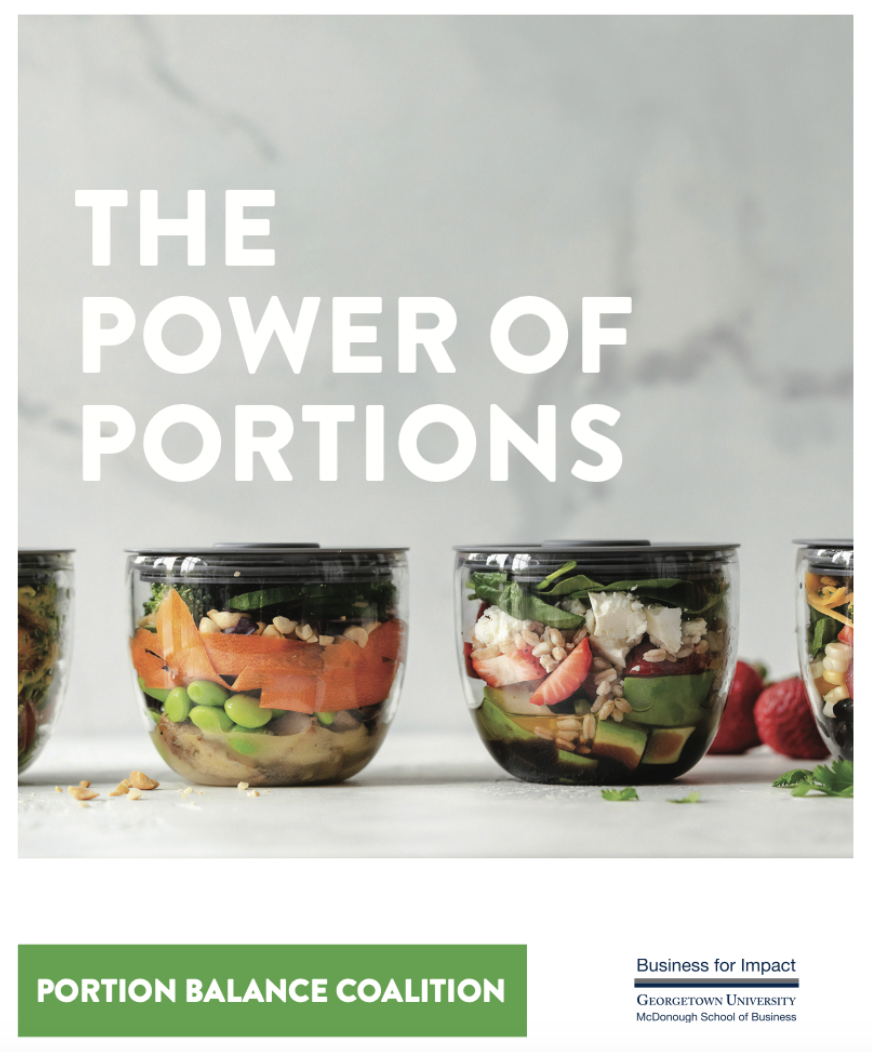
“Power of Portions” Research Report
Released March 19, 2024, the PBC’s Power of Portions Research Report provides a "state of the union" assessment of food portions and their impact on obesity, food waste and sustainability.